
The 7 Most Common Faults We Find on Used Cars in Melbourne
The most common fault on a used car is not the engine or the gearbox. It is worn suspension, found at moderate level or worse on 30 of every 100 cars in the Instant Auto Reach Inspection Index. Here are the seven fault areas our inspectors find most, counted from 100 reports rated on the Instant Auto Reach Severity Scale. Rank Fault area Cars out of 100 1 Suspension bushes, shocks and links 30 2 Engine oil leaks or residue 26 3 Cooling system 21 4 Driveline 19 5 Brakes 18 6 Fault codes or warning lights 17 7 Tyres 15 1. Worn suspension bushes, shocks and links Front lower control arm bushes are the single item we write up most. They crack and perish with age, and a short test drive will not show it. We found them cracked on a 2015 Toyota FJ Cruiser at 106,316 km, a 2018 Toyota Vitz Hybrid and even a 2024 Tesla Model Y. Read more in control arm bushes, our top finding. 2. Engine oil leaks or residue These range from light seepage at a rocker cover to a suspected rear main seal, which means separating the gearbox from the engine to fix. A freshly washed engine bay is a flag in itself. We explain how we tell them apart in oil leaks on used cars. 3. Cooling system faults Low coolant with no visible leak was the most common pattern. In the worst cases we found oil in the coolant or coolant residue under the oil cap, both possible signs of a head gasket problem. See low coolant explained. 4. Driveline wear Leaking CV boots, cracked driveshaft couplings and, on 4WDs, differential locks that would not engage. If you are buying a ute, our ute and 4WD inspection tests low range and the diff lock, not just the road manners. 5. Brakes Mostly worn pads and wavy or lipped rotors. These are cheap on a small hatch and expensive on an AMG. They also decide whether a car passes a roadworthy certificate. 6. Fault codes and warning lights A scan tool sees what a test drive cannot. We clear stored codes, road test, then scan again to see what comes back. The method is in stored vs current fault codes. 7. Tyres Worn tyres are easy money in a negotiation. Uneven shoulder wear also points to alignment or suspension problems, which loops back to fault number one. What is not on the list Previous body repair appeared on 9 in 100 cars and rust on 6 in 100. Less common, but far more serious when found. One car in the Index had been written off twice. How to use this list Most of these seven are negotiation items, not deal breakers. One buyer told us in a Google review that our inspector found an oil leak, which really helped when negotiating the price. Our guide on how to negotiate after an inspection shows how to turn a report into a number. The full dataset is in what 181 Melbourne inspections found. To get these checks on the car you are looking at, book a pre-purchase inspection.
What 181 Melbourne Pre-Purchase Inspections Actually Found
Most advice about buying a used car is opinion. This is not. We went back through 181 of our own pre-purchase inspection reports from across Greater Melbourne and counted what our inspectors actually found. We call the dataset the Instant Auto Reach Inspection Index. The short version, in the 100 reports with severity rated findings, 55 cars had at least one major or critical fault, and only 10 had nothing rated moderate or worse. The cars we inspected The typical car in the Instant Auto Reach Inspection Index is a 2016 model with about 114,000 km on the odometer. One in five had travelled more than 200,000 km. Make Reports Toyota 53 Ford 16 Mercedes-Benz 15 Mitsubishi 13 Honda 10 Hyundai 9 Mazda 9 Holden 8 Tesla, Volkswagen, Lexus 6 each BMW 5 The rest covers 13 more makes, from BYD and Kia to Hino and Mack trucks. Eleven were fully electric. How many used cars were in fair or poor condition? Of the 135 reports where the inspector gave an overall condition rating, 40 cars (30%) were rated fair or poor. Overall rating Cars Share Very good or excellent 47 35% Good 46 34% Fair 23 17% Poor 17 13% Not classified (for example, inspection stopped) 2 1% Nearly one in three is a lot. These were cars a buyer liked enough to pay for an inspection. Does condition drop with kilometres? Yes, and sharply after 100,000 km. Odometer Cars rated Fair or poor Under 100,000 km 61 9 (15%) 100,000 to 200,000 km 48 19 (40%) Over 200,000 km 21 10 (48%) Low kilometres did not mean safe. A 2017 truck at 68,143 km was rated poor, and a 2017 sedan at 88,843 km had a suspected head gasket leak. We cover this in what the data says about high kilometre cars. What faults did we find most often? Our newer reports rate every finding on the Instant Auto Reach Severity Scale, Critical, Major, Moderate, Minor or Monitor. Across the 100 reports that use it, this is how many cars had each type of fault at moderate level or worse. Fault area Cars out of 100 Suspension bushes, shocks and links 30 Engine oil leaks or residue 26 Cooling system 21 Driveline (driveshaft, CV, diff, clutch, transmission) 19 Brakes 18 Fault codes or warning lights 17 Tyres 15 Steering or pulling 11 Engine oil level wrong 10 Previous body repair or damage 9 12V battery 9 Rust or corrosion 6 Service history missing or unverified 6 We break down the top of this list in the 7 most common faults we find. How serious were the faults? Critical findings included structural chassis damage, suspected head gasket failure, excessive engine blow by and a car with finance still owing. See the critical faults, car by car. What about electric cars? We measured battery State of Health (SoH), meaning how much battery capacity is left, on used EVs with an AVILOO test. Readings ran from 82% on a 2019 Tesla Model 3 at 164,136 km to 99.1% on a 2023 Kia EV6. The full table is in our used EV battery health results, and you can book an EV battery health check in Melbourne on its own. What buyers said afterwards Our Google reviews sit at 5.0 from 55 reviews. One buyer put the numbers above in plain words: “They saved me a lot of money. The first few cars I liked, but the reports showed they were lemons. The last report enable me to buy a car I was happy with. Great if your not a mechanic.“ How we counted If you manage vehicles for a business, the same method applies to a fleet vehicle inspection before purchase or disposal.
How to Negotiate a Used Car Price After a Pre-Purchase Inspection
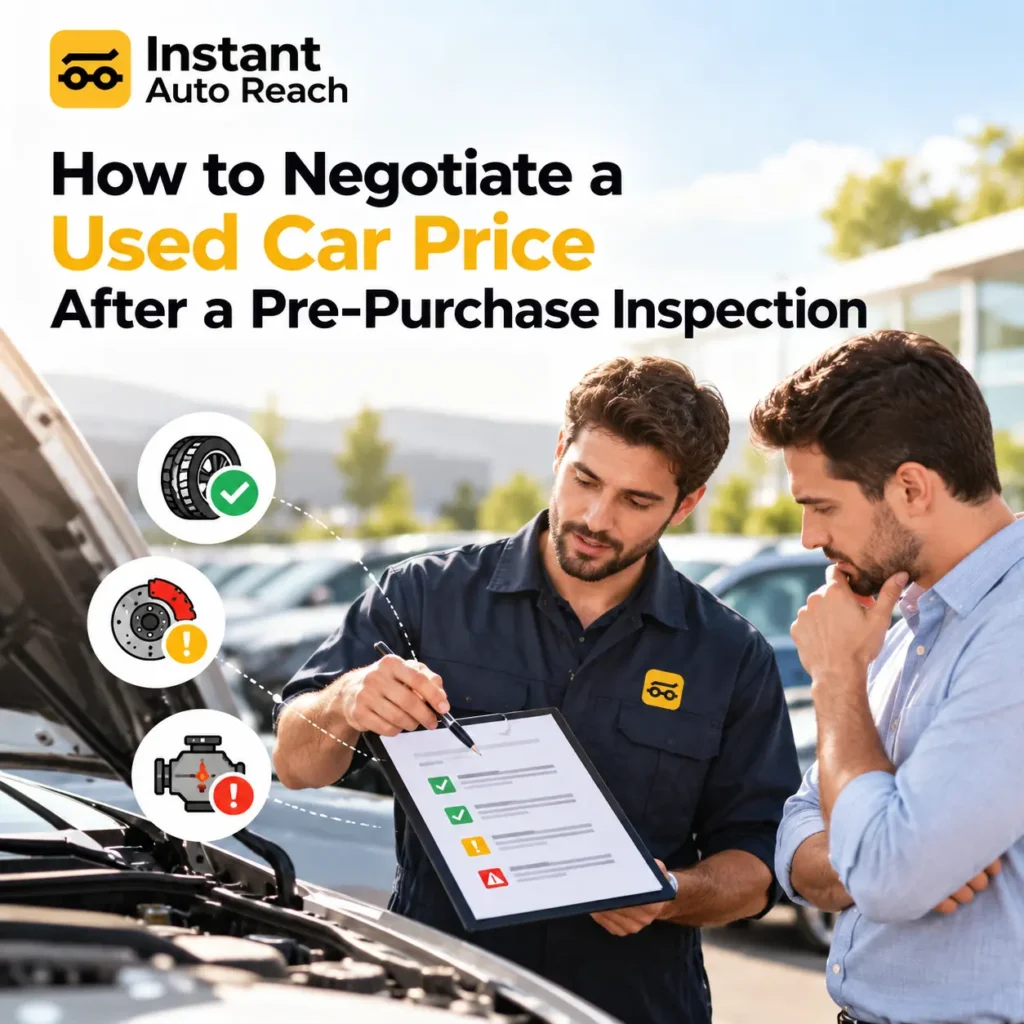
A pre purchase inspection is not only useful for deciding whether to buy a car. It can also give you a much better basis for negotiating the price. The key is to negotiate from evidence rather than turning every inspection finding into a reason to demand a discount. Start by separating findings into categories Not every inspection finding deserves the same response. Start by grouping the findings into four practical categories, normal wear, maintenance due, repair required and significant risk. A worn tyre and a major transmission problem are both ‘issues’, but they do not have the same impact on the purchase decision. Normal wear is not the same as a defect Used vehicles are not new vehicles. Minor cosmetic marks, some age related wear and components that are approaching normal service intervals may be reasonable depending on the vehicle’s age, mileage and price. Your negotiation is stronger when you focus on material issues rather than trying to turn every minor observation into a discount. Use actual repair exposure Where possible, obtain a reasonable repair estimate or ask a qualified professional about the likely cost and urgency. A documented repair requirement is much easier to discuss than ‘the mechanic said it needs work.’ Keep the discussion factual, what was found, how serious it is, whether it is safe to drive, whether it needs immediate attention and what the likely repair exposure is. Examples of issues that can affect negotiations Tyres close to replacement. Brake components requiring replacement. Suspension components with measurable wear. Oil or coolant leaks. Transmission problems. Cooling system concerns. Accident or structural repair concerns. Missing or overdue major servicing. EV battery condition that is materially different from what you expected. Don’t negotiate the full repair bill automatically A common mistake is to add every possible future maintenance item and ask the seller to deduct the entire amount. That can quickly become unrealistic. Instead, focus on issues that are current, material and supported by the inspection. If something is simply normal maintenance due soon, it may be more appropriate to factor it into your overall valuation rather than demand a dollar-for-dollar deduction. Use the inspection report, not emotion Keep the conversation calm and specific. Instead of saying ‘This car is a mess, “say, ‘The inspection identified these three issues, and we need to account for the likely repair cost and risk.” You are not trying to prove the seller did something wrong. You are trying to agree on a price that reflects the condition of the vehicle. What if the seller says another buyer will pay more? You do not have to make a decision based on pressure. If the vehicle is genuinely worth the asking price to you after considering the inspection findings, proceed. If the numbers no longer make sense, it is reasonable to step back. A good inspection is useful partly because it gives you information before you become emotionally committed to the purchase. When should you walk away? Consider stepping away when the inspection identifies serious safety or structural concerns, major mechanical problems, significant unexplained history, or a level of repair exposure that no longer makes financial sense for the vehicle. For EVs, a battery result that materially changes your expected ownership value should be treated as a major part of the decision, not a minor footnote. A simple negotiation script Start with the agreed vehicle price. Identify the material inspection findings. Explain which findings affect immediate or near-term cost. Show supporting evidence where available. Make a specific, reasonable revised offer. Give the seller time to respond. Be prepared to proceed, renegotiate or walk away. How Instant Auto Reach inspection helps The point of a buyer focused inspection is not to tell you what price to pay. It is to give you better information about the vehicle’s condition. With the right findings in front of you, you can decide whether to accept the asking price, negotiate, request repairs or move on to another vehicle. Frequently Asked Questions
Complete Used Car Buying Guide Australia – What to Check Before You Buy
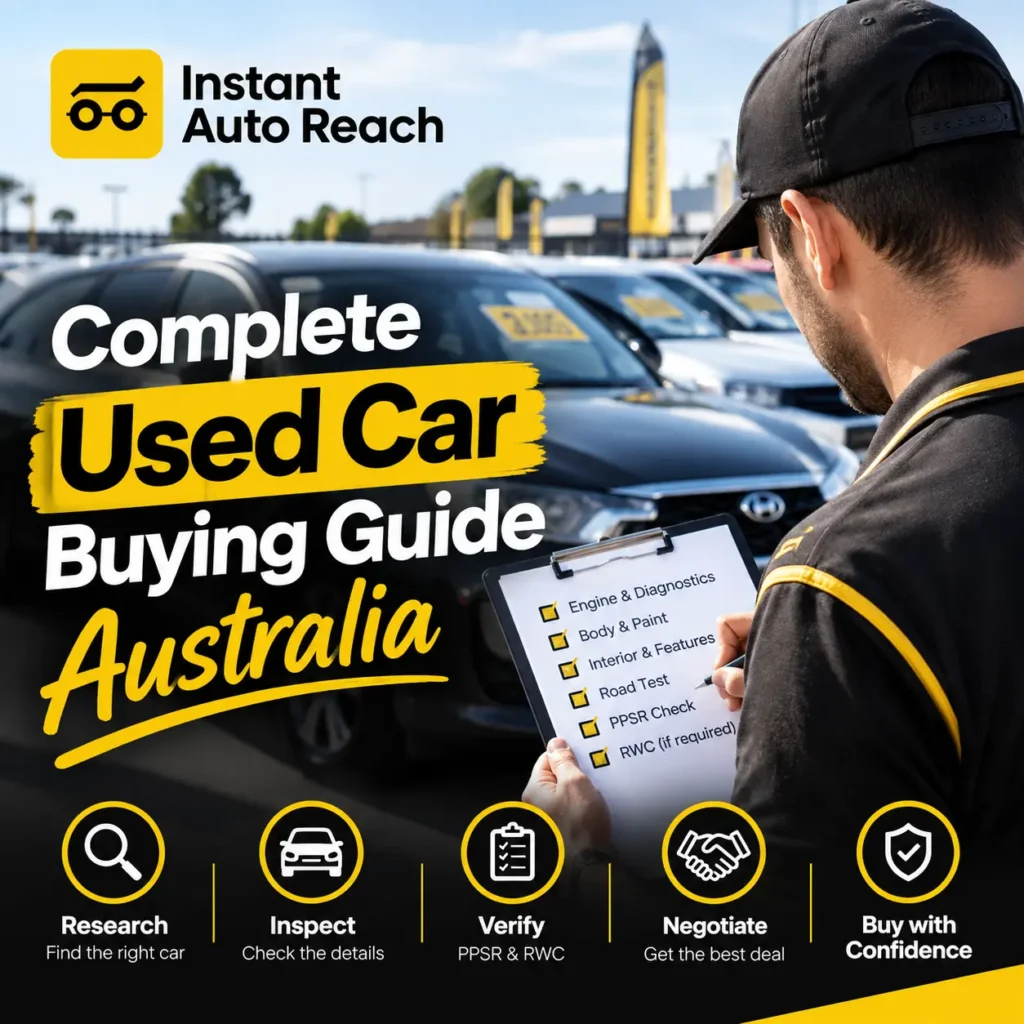
Buying a used car is not just about finding the right make, model and price. You are also deciding whether the particular vehicle in front of you is worth the money being asked for it. This guide walks you through the process from the first search to the final payment, with a focus on the checks that can reduce avoidable surprises. 1. Start with a realistic budget Set the purchase budget first, then leave room for registration, insurance, servicing, tyres, repairs and other ownership costs. The cheapest car to buy is not always the cheapest car to own. For older or higher kilometre vehicles, keep a repair buffer. For EVs, consider charging access and the condition of the battery as part of the overall purchase decision. 2. Choose the right vehicle for your use Think about how the car will actually be used: commuting, family trips, towing, long-distance driving, rideshare, city driving or occasional weekend use. For an EV, consider charging access and expected range. For a hybrid, consider both the combustion and high voltage systems. For a 4WD or UTE, consider towing, modifications and underbody use. 3. Research the model – then the individual car Model research is useful for understanding common maintenance needs, specifications and ownership considerations. But a good reputation for a model does not guarantee that an individual used example is in good condition. The vehicle’s age, mileage, service history, accident history, previous use and maintenance matter. 4. Verify the vehicle identity Before paying a deposit, make sure the VIN or chassis number, registration details and vehicle details are consistent. If something does not match, stop and clarify it. 5. Run a PPSR search A current PPSR search can tell you whether a security interest is recorded and may provide stolen or written-off information where available. It does not replace a mechanical inspection. For private purchases, the PPSR is particularly important because the register can affect the risk associated with a vehicle carrying a security interest. 6. Review service history Look for evidence of servicing, major maintenance and previous repairs. Check whether the recorded mileage makes sense across the documents. If the seller says a major component has recently been replaced, ask what was replaced, when, and whether supporting documentation is available. 7. Inspect the vehicle before you commit Look at the body, paint, tyres, wheels, glass, lights, interior, engine bay and visible mechanical components. Then assess the vehicle on the road. Do not rely only on a seller’s statement that a mechanic has looked at it. Ask what was checked and whether you can review the report. For higher value or complex vehicles, an independent pre-purchase inspection gives you a buyer-focused assessment rather than relying only on the seller’s description. 8. Test drive properly Check starting, acceleration, braking, steering, transmission, suspension, noise and temperature. Where appropriate, drive at different speeds and over different road surfaces. If you are unfamiliar with the vehicle, ask an experienced person or independent inspector to assess the driving behaviour. 9. Understand the role of an RWC In Victoria, a roadworthy certificate is intended to show that the vehicle is safe enough to be used on public roads. It is not a full mechanical-quality or reliability report. If an RWC is required for your transaction, use an accredited/licensed tester and treat the certificate as a separate requirement from a buyer-focused condition inspection. 10. For EVs, investigate the battery The battery is a central part of a used EV’s value and usability. Government guidance notes that battery State of Health (SOH) information can help when buying or selling a second hand EV. A battery health assessment can provide information that a dashboard range estimate alone cannot. If battery condition is important to the purchase, consider an independent battery test. 11. Negotiate using evidence Do not negotiate simply because ‘used cars always have problems.’ Use actual findings, tyres, brakes, suspension, leaks, damage, service requirements, battery condition and other documented issues. The stronger your evidence, the easier it is to have a sensible conversation about price. 12. Do the final checks before payment Reconfirm the vehicle identity, PPSR result, agreed price, inclusions, service documents, keys, accessories and payment arrangements. If something material changes between inspection and handover, stop and investigate it. 13. Keep your records Save the PPSR certificate, inspection report, service documents, receipts, sale contract and any written promises made by the seller. These records can be useful later for servicing, resale and resolving questions about what was represented at the time of purchase. A simple buying sequence Choose the right vehicle. Verify the VIN and vehicle details. Run the PPSR. Review service history. Arrange an independent inspection. Test drive. Check RWC requirements if relevant. Negotiate using evidence. Complete final checks. Keep your purchase records.
Used Car Inspection Checklist Australia
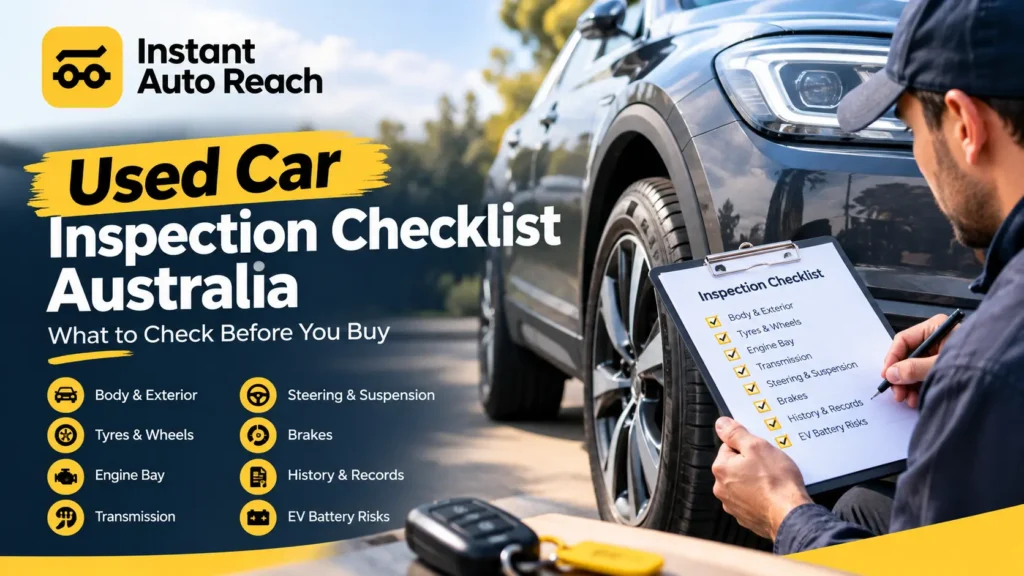
A used car can look excellent in an online listing and still have problems that are difficult to spot in ten minutes at the seller’s driveway. This checklist gives you a practical way to inspect the vehicle before you buy. It is useful for private sale and dealer vehicles, but it is not a substitute for a professional inspection when you need a deeper assessment. Before you inspect the car Ask for the VIN and compare it with the vehicle. Check the advertised mileage against the dashboard and available records. Ask whether the vehicle has been in an accident, flood or major repair and whether service records are available. Run a current PPSR search before you buy. The PPSR can reveal a registered security interest and may provide stolen or written off information where available. If possible, inspect the vehicle in daylight and when the engine is cold. A cold start can reveal symptoms that may be less obvious after the vehicle has warmed up. 1. Check the exterior and body Walk around the entire vehicle before starting it. Look at panel gaps, paint colour differences, overspray, dents, scratches and signs of repair. Look closely at areas where panels meet. Uneven gaps or mismatched paint do not automatically prove accident damage, but they are reasons to investigate further. Check the windscreen and windows for chips, cracks and damage. Look at lights, indicators, mirrors and exterior trim. 2. Check tyres and wheels Check tread depth and look for uneven wear. Uneven wear can be a clue to alignment, suspension or other issues. Look for sidewall damage, cracks and bulges. Check that the tyres are reasonably consistent with the vehicle and that the wheels do not show obvious impact damage. 3. Check the engine bay Look for visible oil, coolant or other fluid leaks. Check fluid levels where appropriate and look for signs of contamination or recent cleaning that may make leaks harder to spot. Inspect hoses, belts and visible components for obvious deterioration. Listen for unusual noises when the engine starts and idles. A clean engine bay is not proof of a healthy engine. It is the underlying condition, not how shiny the components look, that matters. 4. Check the transmission and drivetrain During the test drive, pay attention to how the vehicle selects gears, accelerates and responds to throttle input. For automatic vehicles, look for harsh engagement, slipping, delayed response or unusual noises. For manual vehicles, check clutch engagement and gear selection. For AWD and 4WD vehicles, drivetrain behaviour and noises deserve particular attention. 5. Check steering, suspension and brakes On the road test, notice steering feel, pulling, vibration, knocking and braking behaviour. Check whether the vehicle sits level and whether there are signs of suspension wear. Listen for knocks over uneven surfaces. Brake performance should be consistent and predictable. Any grinding, pulsation or unusual noise deserves further investigation. 6. Check the interior and electronics Test the major switches, windows, mirrors, climate control, infotainment, cameras and other equipment that matters to you. Look at warning lights during the ignition sequence and after the vehicle starts. A warning light that disappears does not necessarily mean the underlying issue never existed. 7. Check the service history Look for evidence of regular servicing and compare the service dates and mileage with the odometer. Ask what major maintenance has already been completed and what is due next. A car can be mechanically sound but still require significant upcoming maintenance. 8. Take a proper test drive A short trip around the block is not always enough. Where safe and permitted, assess the vehicle at different speeds and road conditions. Listen for noises, check acceleration, braking, steering, transmission behaviour and temperature. Pay attention to anything that feels different from what you would expect from the vehicle. 9. EV and hybrid checks For an EV, the battery deserves separate attention. Dashboard range alone does not give you a complete assessment of battery health. Consider an independent battery health test that provides a State of Health result and supporting diagnostic information. For hybrids, assess both the combustion engine and the hybrid system. A hybrid is not simply a petrol car with a larger starter battery; the high voltage system and related components need appropriate assessment. 10. What a DIY checklist cannot tell you A checklist is useful for screening a vehicle, but it has limits. You may not have access to a scan tool, lift, specialist EV battery diagnostics or the experience needed to interpret symptoms. If the car is expensive, complex, older, high-mileage or simply important to you, an independent inspection can turn a long list of observations into a structured condition report. Quick used car checklist VIN matches the vehicle. Current PPSR completed. Service history reviewed. Cold start checked. Body and paint inspected. Tyres and wheels checked. Engine and fluids checked. Transmission and drivetrain assessed. Steering, suspension and brakes assessed. Warning lights and electronics tested. Road test completed. EV battery / hybrid system considered where relevant. Independent inspection arranged if you want a deeper assessment. The practical takeaway You do not need to become a mechanic to buy a used car carefully. You do need a process. Start with the vehicle identity and history, inspect the physical condition, test drive it properly and investigate anything that does not make sense. If you would rather have a qualified inspector do the detailed work, our mobile pre purchase inspection service comes to the vehicle and provides a structured report so you can make the decision with clearer information.
PPSR vs Pre Purchase Inspection – Do You Need Both?
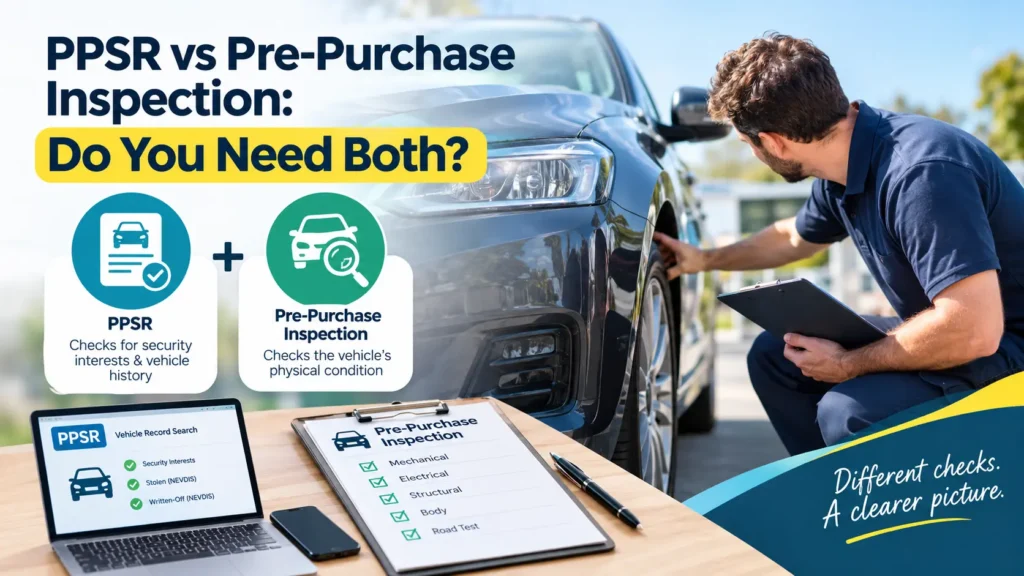
If you are buying a used car, it is easy to think a single check should tell you everything. It does not. A PPSR search and a pre purchase inspection look at different parts of the risk. One is primarily about registered security and certain vehicle history information; the other is about the vehicle’s physical and mechanical condition. PPSR vs pre purchase inspection at a glance The simplest way to understand the difference is this, PPSR is a records and security interest check, a pre-purchase inspection is a physical and mechanical assessment. Neither one replaces the other. If you are spending a significant amount on a used vehicle, combining them can give you a more useful picture before you commit. What a PPSR checks A motor vehicle PPSR search can show whether a security interest is recorded against the vehicle. It can also include stolen or written-off information from NEVDIS where available. The official PPSR search also produces a certificate you can keep as a record. That is valuable because a car can look perfect and still have a registered security interest or a history issue you would not discover from a test drive. What a pre-purchase inspection checks A professional pre-purchase inspection is concerned with the condition of the vehicle itself. At IAR, our inspection approach covers the mechanical, electrical, structural, body and road-test aspects of the vehicle, depending on the package and vehicle. The purpose is to identify defects, wear, damage, warning signs and potential repair exposure before you buy, not simply to confirm that the car starts and drives. What PPSR does not tell you PPSR does not tell you whether the engine is healthy, whether the transmission is operating properly, whether the suspension is worn, whether the brakes or tyres are close to replacement, or whether an electrical fault is present. The PPSR itself also states that it does not provide the amount of finance owing, ownership history, odometer reading or outstanding fines. What a pre-purchase inspection does not replace A physical inspection does not replace a current PPSR search. An inspector can find evidence of repairs, damage or mechanical problems, but a physical inspection does not create the legal record provided by a PPSR search. The strongest approach is to treat the checks as complementary rather than choosing one because it seems easier. What about a roadworthy certificate? A roadworthy certificate is different again. In Victoria, a roadworthy certificate is intended to show that a vehicle is safe enough to be used on public roads. Transport Victoria makes clear that a roadworthiness inspection is not a check of the vehicle’s overall mechanical quality or reliability. That is why a roadworthy certificate should not be treated as a replacement for a buyer-focused pre-purchase inspection. The three-check framework PPSR: Is there a registered security interest or certain recorded vehicle-history information I need to know about? Pre-purchase inspection: What condition is the vehicle actually in? Roadworthy certificate: Does the vehicle meet the applicable roadworthiness requirements? These checks answer different questions. The right combination depends on the vehicle, transaction and your risk tolerance. When should you do each check? Run the PPSR close to the purchase transaction, using the correct VIN or chassis number. Arrange the physical inspection before committing to the purchase, ideally while there is still time to negotiate or walk away. If a roadworthy certificate is required for your transaction, confirm the current Victorian requirements and use an authorised tester for the certificate. If the inspection finds problems The value of an inspection is not that every vehicle must pass with no faults. Used cars naturally have wear and age-related issues. The useful question is whether the findings are minor, expected, repairable, expensive, safety-related or significant enough to change the purchase price or your decision. That information gives you something much stronger than a vague feeling that the car ‘seems okay.’ Bottom line If you are buying a used car, PPSR and a pre-purchase inspection are not competing products. They are different checks for different risks. For Melbourne buyers, we recommend treating the PPSR as the records check and the pre-purchase inspection as the physical condition check. If an RWC is also relevant, treat that as a separate roadworthiness requirement rather than assuming one document answers everything.
PPSR Check Before Buying a Used Car in Australia
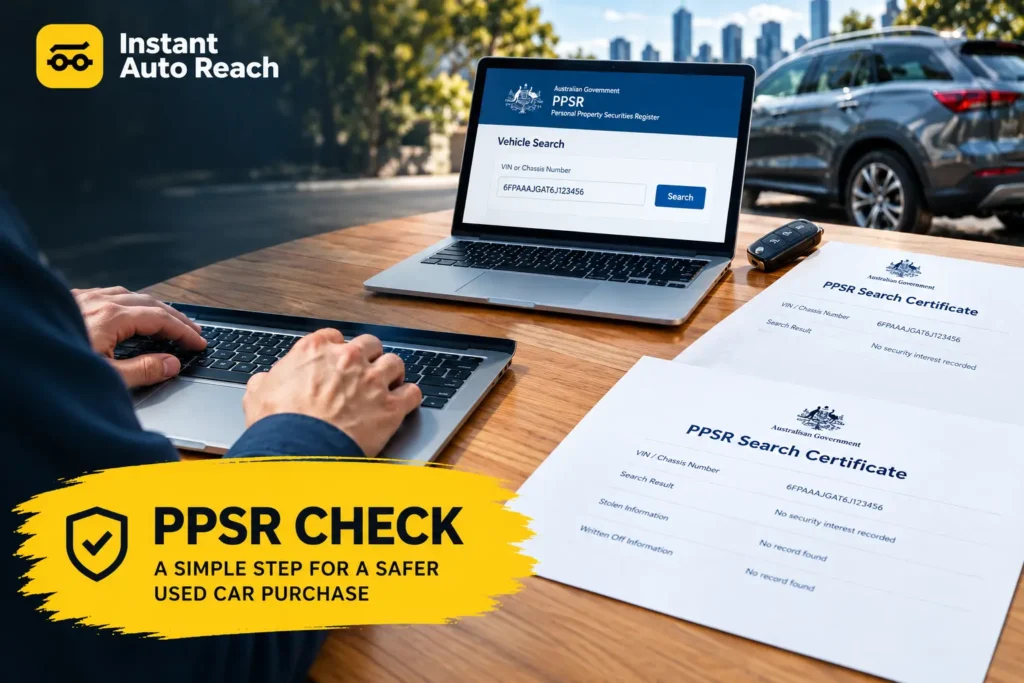
You can find a car that looks great, drives well and fits your budget. and still have a problem you cannot see from the driveway. Before buying a used car, a PPSR check is one of the simplest checks you can do. It is designed to help you identify certain legal and vehicle-history risks, including a registered security interest and, where available, stolen or written-off information. What is a PPSR check? PPSR stands for Personal Property Securities Register. It is the Australian Government register used to record security interests in personal property. For a used vehicle buyer, the important point is practical: a motor vehicle search can show whether a security interest is recorded against the vehicle and may also provide written-off and stolen information where the relevant data is available. The official PPSR vehicle search currently costs $2. The search uses the vehicle identification number (VIN) or chassis number. Because the result is tied to the vehicle identifier, enter the VIN carefully and make sure it matches the vehicle you are actually considering. What can a PPSR search tell you? A PPSR search can tell you whether a security interest is recorded against the vehicle. In plain English, this can indicate that money is still owing against the vehicle and that a financier may have rights over it. The search may also show information supplied through the National Exchange of Vehicle and Driver Information System (NEVDIS), including whether the vehicle has been reported as stolen or written off. The availability and accuracy of NEVDIS information are managed by the relevant road agencies and police, not by the PPSR itself. The PPSR also provides a search certificate. Keep the certificate with your purchase records. Why finance owing matters This is one of the biggest reasons to do a PPSR search. If a security interest remains registered against a vehicle you buy privately, the secured party may have rights that affect the vehicle even though you have paid the seller. If the PPSR shows an existing security interest, do not assume that a seller’s statement such as ‘the loan is paid’ automatically resolves the issue. The safer approach is to understand the PPSR result and arrange for the registered interest to be released or otherwise resolved before completing the purchase. Does PPSR show if a car has been written off? It can, where the relevant NEVDIS information is available. Written-off information can be particularly important after serious accidents, floods, hail or other events. A PPSR result is not a substitute for physically inspecting the vehicle. A vehicle can have repair history or condition issues that a PPSR search does not fully describe. If a vehicle has a concerning history result, get the relevant records clarified before you buy and consider an independent inspection. Does PPSR show if a car is stolen? A motor vehicle PPSR search may include stolen status information from NEVDIS where available. If the search identifies a stolen-vehicle issue, stop and seek clarification from the relevant authority rather than relying on the seller’s explanation alone. What does a PPSR check NOT tell you? This is where buyers often misunderstand the PPSR. It is not a mechanical inspection and it is not a complete vehicle history report. The official PPSR says a vehicle search does not provide all information about the vehicle. For example, it does not provide the amount of finance owing, the vehicle owner or ownership history, the odometer reading, or outstanding fines. It also cannot tell you whether the engine is healthy, whether the transmission is slipping, whether the suspension is worn, whether a warning light has been recently cleared, or whether an accident repair has been carried out to a high standard. Those are physical and mechanical questions. PPSR and a pre-purchase inspection work together Think of the two checks as answering different questions. PPSR asks: ‘Is there a registered legal/security or certain recorded vehicle-history issue I need to know about?’ A pre-purchase inspection asks: ‘What condition is this vehicle actually in right now?’ For a buyer, doing both creates a much more complete picture before money changes hands. When should you do the PPSR? For a private purchase, do the search as close to the transaction as practical. The PPSR itself explains that timing matters for certain buyer protections, including making the search on the actual day or day before the sale and searching the correct serial number. If the seller gives you a previous PPSR certificate, you can use it as information, but consider doing your own current search before buying so you know what the register says at the time of the transaction. What if the PPSR comes back with a problem? Do not automatically assume every result means the vehicle must be rejected. First identify exactly what the result means and whether the issue can be properly resolved. For a security interest, ask the seller to arrange release of the interest through the relevant financier. For written-off or stolen information, seek clarification from the appropriate road authority or police as directed by the PPSR. If the history is concerning, combine the records check with an independent physical inspection before making a decision. PPSR checklist before buying a used car Get the vehicle VIN or chassis number. Run your own current PPSR search. Check the vehicle details match the car in front of you. Read the security-interest result carefully. Check available stolen and written-off information. Save the search certificate. Arrange an independent pre-purchase inspection. Use the inspection findings and history information together when negotiating or deciding whether to proceed. FAQs A PPSR check is inexpensive, quick and useful, but it answers only part of the used-car buying question. It can help you identify finance/security interests and, where available, stolen or written-off information. It does not tell you whether the engine, transmission, suspension, brakes, battery or body are in good condition. If you are buying a used car in Melbourne and want the vehicle physically assessed as well, our mobile pre-purchase inspection
EV Inspection Melbourne Cost & – What Should You Pay?
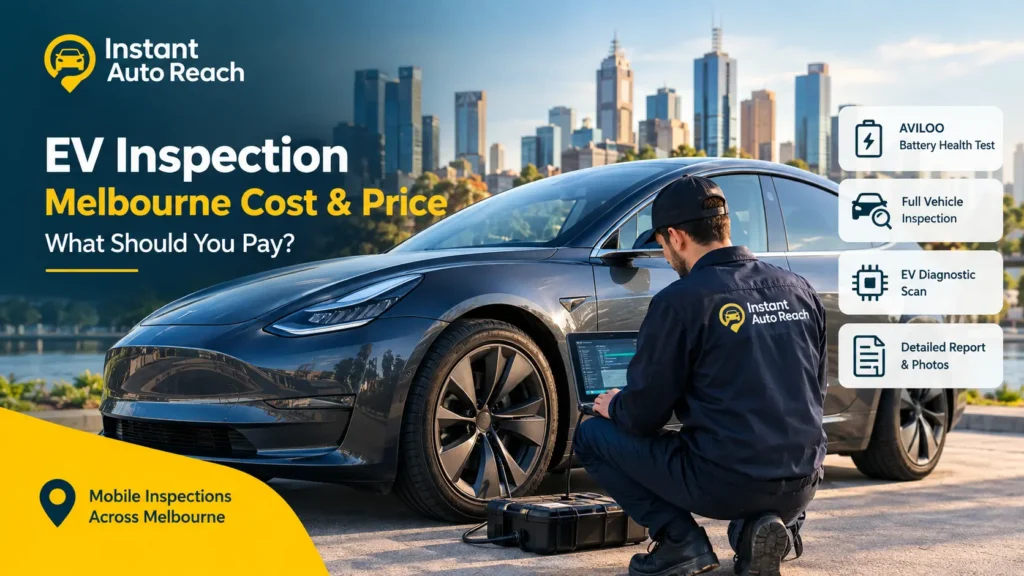
If you’re buying a used electric vehicle in Melbourne, one of the first questions you’ll probably ask is: how much does an EV inspection cost? The answer depends on what is included in the inspection. Some providers advertise a low starting price for a basic inspection, while battery health testing may be an additional service. Others may charge different amounts depending on the vehicle, location or inspection requirements. At Instant Auto Reach, we keep our pricing straightforward. Our EV inspection services have flat, upfront charges with no surprise surcharges. You know what you’re paying before the inspection is booked. Our Standard EV Inspection costs $550 including GST and includes a comprehensive vehicle inspection plus an AVILOO battery health test. We also offer a $350 AVILOO battery-only test and a $795 Premium EV Inspection for buyers who want additional information and support. Even more importantly, we offer same day EV inspections across Melbourne, subject to availability. If you’ve found the right EV today, you don’t necessarily have to wait several days to get it checked. EV Inspection Melbourne Cost at a Glance Here are the current Instant Auto Reach prices: EV Service Price What’s Included AVILOO Battery Test $350 incl. GST Independent AVILOO battery health assessment and report Standard EV Inspection $550 incl. GST Full EV inspection + AVILOO battery test + diagnostics + test drive + detailed report Premium EV Inspection $795 incl. GST Standard inspection plus additional history, video, model-specific information and negotiation support Flat Pricing. No Surprise Surcharges. One of the advantages of booking with Instant Auto Reach is that our advertised prices are flat charges. There are no unexpected inspection surcharges added simply because you have chosen a particular vehicle or need a mobile inspection. We believe you should know the cost before you book. That’s especially important when you’re already making a significant investment in a used EV. How Much Does an EV Inspection Cost in Melbourne? Across Melbourne, EV inspection prices vary depending on the provider and the level of inspection being offered. Publicly advertised services in the market include EV inspections from around the $295+ range, while some specialist providers advertise comprehensive inspections with independent AVILOO battery certification from around $525. Other providers offer battery testing separately or as an add-on. This makes comparing the headline price alone potentially misleading. For example, an inspection advertised at $299 might look considerably cheaper than a $550 inspection. But if the cheaper inspection doesn’t include an independent battery health assessment, you may need to pay extra for the battery test. The better question is: What am I actually getting for the price? At Instant Auto Reach, our $550 Standard EV Inspection includes the vehicle inspection and AVILOO battery test together. That means you can assess both the overall condition of the EV and the health of its high-voltage battery as part of the same service. What Does the $550 Instant Auto Reach EV Inspection Include? Our Standard EV Inspection is designed for buyers who are seriously considering purchasing a used electric vehicle. Full Vehicle Condition Assessment Our inspector checks the vehicle’s overall condition and looks for issues that could affect its safety, reliability, usability or value. An EV still has many components that need to be assessed, including: EVs have fewer traditional mechanical components than petrol or diesel vehicles, but that doesn’t mean they don’t require a thorough pre-purchase inspection. AVILOO Battery Health Test The high-voltage battery is one of the most important components of an electric vehicle. Our Standard EV Inspection includes an AVILOO battery health test and report. The test provides information about battery State of Health (SoH) and degradation, giving you an independent assessment that goes beyond simply looking at the vehicle’s displayed range. This can be particularly valuable when buying a used EV because two vehicles of the same age, model and mileage can have different battery conditions. EV Diagnostic Scan Modern EVs rely heavily on electronic systems and software. Our inspection includes diagnostic scanning to help identify relevant stored faults and issues that may not be obvious during a visual inspection. Test Drive The vehicle is also assessed during a test drive. This helps identify potential issues with driving performance, braking, steering, suspension and general operation that may not be apparent while the vehicle is stationary. Detailed Photos and Report You’ll receive a detailed digital inspection report with photographs so you can review the vehicle’s condition. If you’re buying from a distance or can’t attend the inspection yourself, this can be particularly useful. Phone Explanation After the inspection, our team can talk you through the findings so you have a clearer understanding of the results before deciding whether to proceed with the purchase. PPSR / Serial Number Certificate The Standard package also includes a PPSR/serial number certificate as part of the inspection process. Why Is EV Battery Testing Important? When buying an electric vehicle, the battery deserves special attention. The battery is one of the most expensive components of an EV and has a major influence on the vehicle’s usable range and long-term value. Looking at the dashboard range isn’t the same as receiving an independent battery health assessment. A vehicle might show a reasonable estimated range, but that doesn’t necessarily tell you the complete story about the battery’s current condition. An AVILOO battery test provides additional information about battery health and degradation, helping you make a more informed purchasing decision. That’s why we include the AVILOO test in our $550 Standard EV Inspection, rather than requiring you to arrange a separate battery assessment after the vehicle inspection. $350 Battery Test vs $550 EV Inspection Not every buyer needs exactly the same service. $350 AVILOO Battery Test The $350 battery-only service may suit you if: $550 Standard EV Inspection For most people buying a used EV, the $550 Standard EV Inspection is the more comprehensive choice. You get: Full vehicle inspection + diagnostics + test drive + detailed report + AVILOO battery health test. Rather than checking just one part of
How Much Does It Cost to Replace an EV Battery in Australia?
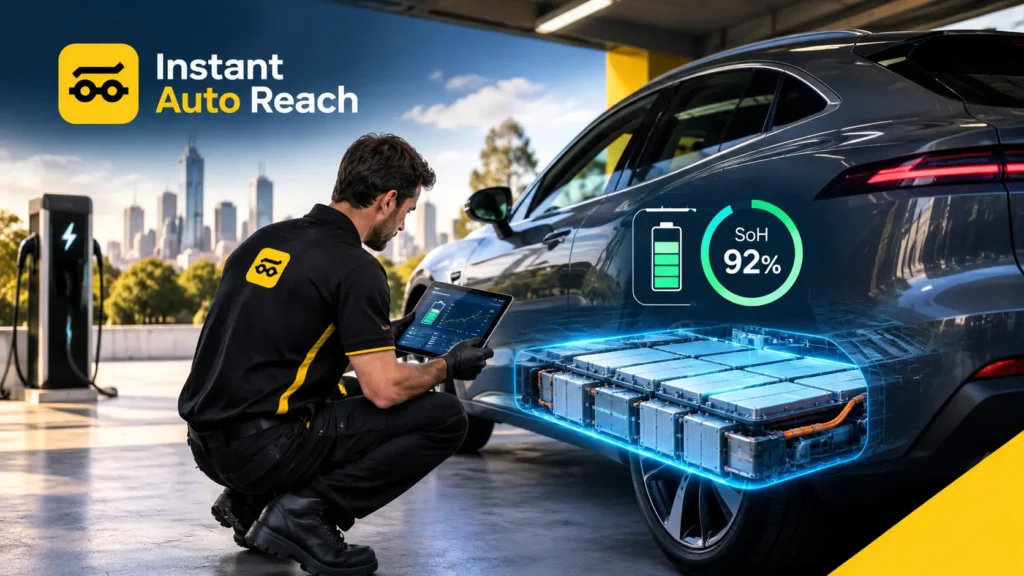
It’s the single biggest fear for anyone buying a used electric car: what if the battery dies and I’m hit with a bill the size of a small car? It’s a fair worry – the battery is the most expensive component in an EV – but the reality is far less scary than the headlines suggest. A full battery replacement in Australia can run anywhere from around $5,000 to $30,000 or more depending on the vehicle, but the vast majority of EV owners will never pay it, because of long warranties and slower-than-expected degradation. Here’s what a replacement actually costs, why you’re unlikely to ever need one, and – most importantly if you’re buying used – how to check a battery’s health before you hand over any money. Why battery cost is the #1 used-EV worry Unlike a petrol engine, where wear is gradual and repairs are incremental, an EV’s value is concentrated in one giant component: the traction battery. On many models it represents a large share of the car’s total value. So the fear is understandable – if it fails out of warranty, the repair can approach the value of the car itself. But that fear is based on a worst-case scenario that rarely plays out. Understanding the difference between “the battery degraded a bit” and “the battery needs replacing” is the key to buying a used EV with confidence. What an EV battery actually costs to replace There’s no single figure, because it depends heavily on the make, model, battery size and whether you’re fitting a new, refurbished or second-hand pack. As a broad guide in the Australian market: Two things soften these numbers over time: independent and refurbished battery options are growing, and module-level repair (replacing only failed cells or modules rather than the whole pack) is increasingly available, which can dramatically reduce the cost of an out-of-warranty fault. The good news – warranties cover most of the risk This is the part that changes the whole picture. Most EVs sold in Australia come with a battery warranty of around 8 years or 160,000 km (whichever comes first), and manufacturers typically guarantee the battery will retain a minimum State of Health – commonly around 70% – within that period. If the battery drops below that threshold while under warranty, it’s repaired or replaced at the manufacturer’s cost. That means a large share of used EVs on the market today are still covered. When you’re buying, one of the first things to establish is how much of that battery warranty remains – it’s often transferable to you as the new owner, and it fundamentally de-risks the purchase. How often do EV batteries actually need replacing? Rarely. Real-world data has consistently shown that modern EV batteries degrade more slowly than early fears suggested. Typical degradation is on the order of 1–2% of capacity per year, and it tends to slow down after the first couple of years rather than accelerate. A well-treated EV can retain the large majority of its original range well beyond 150,000 km. Outright battery failure (as opposed to gradual capacity loss) is uncommon and, when it happens within warranty, is the manufacturer’s problem, not yours. The realistic risk for a used buyer isn’t “the battery will die” – it’s “the battery has quietly lost more capacity than the seller is letting on.” How to avoid buying an EV that needs a new battery This is where a used-EV purchase is won or lost. You cannot judge battery health from the dashboard range estimate – it’s based on recent driving and can be misleading or even reset. The only reliable way to know a used EV’s true condition is an independent battery health test that reads the actual State of Health (SoH). The NRMA and independent specialists both offer this kind of check, which produces a score out of 100 reflecting the battery’s real remaining capacity versus when it was new. We explain how to read those numbers in our guide on how to check EV battery health. At Instant Auto Reach, our EV battery check in Melbourne uses a certified Aviloo test to give you an independent SoH score you can trust – and use to negotiate. It’s part of our full EV inspection service, which also checks the charging system, motor, electronics and everything a standard pre-purchase inspection covers. What State of Health should you look for? As a rough guide: One extra nuance: LFP batteries (common in many BYD and entry Tesla models) and NMC batteries (in many longer-range EVs) age differently, so a good testing service interprets the score in the context of the specific chemistry and model. The bottom line Yes, replacing an EV battery in Australia can be expensive – but it’s a cost most owners never face, thanks to long warranties and slow, predictable degradation. The real risk when buying used isn’t a dead battery; it’s an undisclosed one that’s lost more capacity than it should have. A simple, independent battery health check removes that risk entirely. Buying a used EV in Melbourne? Get the battery checked before you pay. Call 0402 220 178 or book an EV battery check online. FAQ
Pre-Purchase Inspection vs Roadworthy Certificate – What’s the Difference?
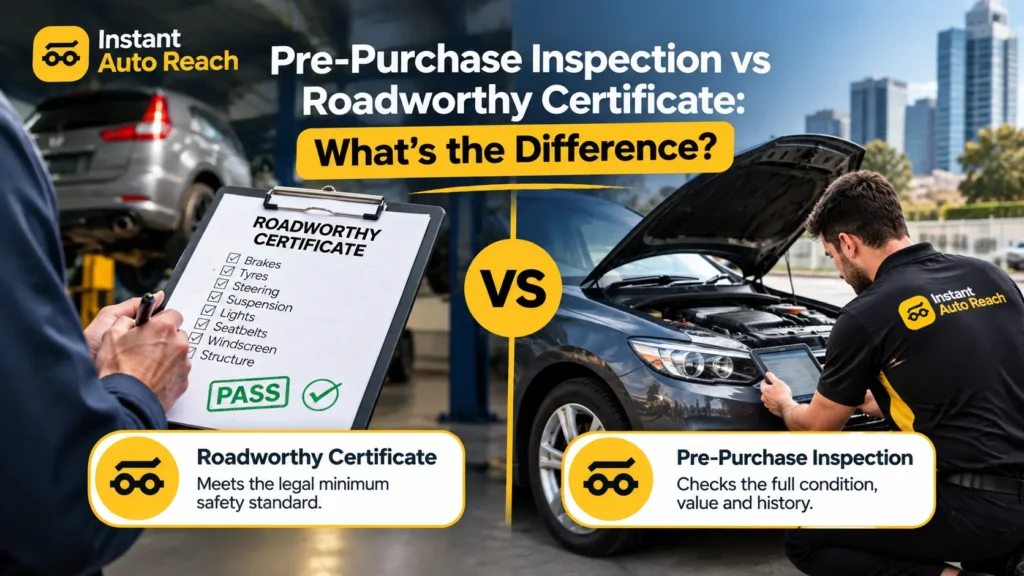
It’s one of the most common – and most expensive – misunderstandings in the used-car world: assuming that because a car has a roadworthy certificate, it’s a good car to buy. It isn’t the same thing. A roadworthy certificate confirms a car meets the legal minimum safety standard to be sold or registered in Victoria. A pre-purchase inspection tells you whether the car is actually worth your money. They serve completely different purposes, and confusing the two can cost you thousands. Here’s exactly how they differ, why a roadworthy is never enough on its own when you’re buying, and which one you actually need. What a roadworthy certificate is A Roadworthy Certificate (RWC) is a legal document. In Victoria, you generally need one to sell a registered vehicle or to re-register one. It’s issued only by a licensed vehicle tester and confirms the car meets the minimum safety standards set by the state – brakes, tyres, steering, suspension, lights, seatbelts, windscreen and structure. You can read the official requirements on Transport Victoria’s roadworthy page, and we break down every component in our guide on what a roadworthy inspection covers. The key word is minimum. A roadworthy is a pass/fail safety check. It does not grade the car, it doesn’t tell you how much life is left in the engine or transmission, and it says nothing about whether the car has been in a major accident. It’s also only valid for 30 days. What a pre-purchase inspection is A pre-purchase inspection (PPI) is a comprehensive, independent assessment of a used car’s overall condition – carried out for the buyer, before you commit. Where a roadworthy asks “is this car legally safe?”, a pre-purchase inspection asks “is this car worth buying, and what’s it going to cost you?” A thorough PPI covers everything a roadworthy does, then goes much further: engine and transmission health, computer diagnostics and fault codes, evidence of previous accident or panel repairs, structural integrity, the condition of major mechanical components, fluid condition and leaks, tyre and brake wear as a cost forecast (not just pass/fail), a road test, and often a title/finance check. You walk away with a detailed report and an honest recommendation: buy, negotiate, or walk away. Side-by-side comparison Roadworthy Certificate Pre-Purchase Inspection Purpose Legal minimum safety standard Buyer’s assessment of overall condition & value Who it’s for The seller (to transfer/register) The buyer (to decide) What it checks Safety items only Safety + mechanical + accident history + diagnostics Mechanical reliability? No Yes Accident/repair history? No Yes Result Pass / fail certificate Detailed report + recommendation Legally required? Yes, to sell/register No – but strongly advised before buying Validity 30 days A snapshot at time of inspection Why a roadworthy is NOT enough when you’re buying This is the part that costs buyers the most. A car can pass a roadworthy and still be a terrible purchase. Because the roadworthy only checks safety items, a vehicle can have a current certificate while hiding: None of those fail a roadworthy, because none of them are strictly “unsafe” on the day of the test. But every one of them can cost you thousands after you’ve handed over the money. A roadworthy protects the transaction’s legality; a pre-purchase inspection protects you. Your buyer protections in Victoria (and why they don’t replace an inspection) Where you buy also changes your protection. Buying from a licensed motor car trader in Victoria comes with statutory rights – a used-car warranty on eligible vehicles and a cooling-off period – as explained by Consumer Affairs Victoria. Buying privately, though, is “buyer beware”: no cooling-off period and no statutory warranty. Whatever’s wrong with the car becomes your problem the moment you pay. That’s exactly why an independent inspection matters most on private sales – and why you should also run a PPSR check to confirm the car isn’t under finance, written off, or stolen. None of that is covered by a roadworthy. So which do you need? In short: a roadworthy and a pre-purchase inspection aren’t competing options – they answer different questions. If you’re buying, don’t let a valid roadworthy talk you out of a proper inspection. It’s the cheapest insurance you’ll ever buy against a bad car. Call Instant Auto Reach on 0402 220 178 or book a mobile inspection online – we come to the car, anywhere in Melbourne, usually the same day. FAQ
What Fails a Roadworthy Certificate in Victoria?
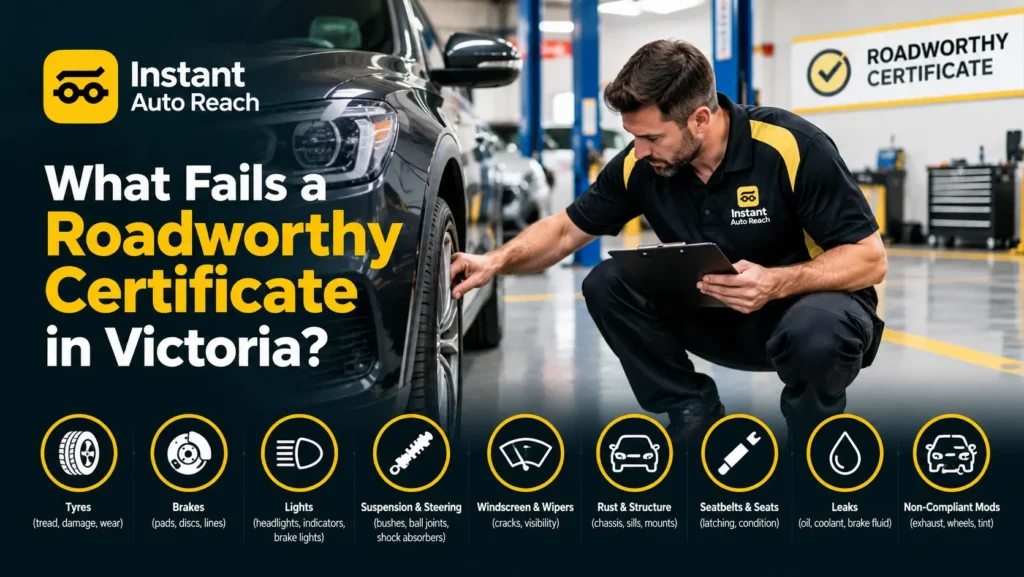
If your car is going to fail a roadworthy in Victoria, it will almost always be for one of a handful of reasons: worn tyres, brakes that are past their limit, blown or misaligned lights, damaged windscreens, perished suspension or steering components, structural rust, or oil and fluid leaks. These are the safety items a licensed vehicle tester is legally required to check – and the ones most likely to catch out an owner who hasn’t had the car looked at recently. A Roadworthy Certificate (RWC) confirms your vehicle meets the minimum safety standard to be sold or re-registered in Victoria. It isn’t a stamp of overall quality or reliability – it’s specifically about safety. Understanding exactly what testers look at (and what they don’t) is the difference between passing first time and paying for a re-inspection. Here’s the full picture, straight from an inspector’s point of view. What a roadworthy actually checks Under the Victorian rules, a roadworthy inspection covers the vehicle’s safety-related components. According to Transport Victoria, the inspection includes: If you want the complete breakdown of every area assessed, we’ve covered it in detail in our guide on what a roadworthy inspection covers. Below, we’re focusing on where cars actually fail. The most common reasons cars fail a roadworthy in Victoria 1. Tyres. This is the number one cause of failures we see. Tyres must have at least 1.5 mm of tread across the whole width, be free of cracks, bulges and exposed cord, and be the correct type and size for the vehicle. Uneven wear – often a sign of a wheel alignment or suspension issue – can also fail. Mismatched tyres across an axle are another common trap. 2. Brakes. Worn brake pads, scored or warped discs, leaking brake lines, a spongy pedal, or a handbrake that won’t hold the car on a slope will all fail. Brakes are non-negotiable for a tester because they’re the single most important safety system on the car. 3. Lights and reflectors. A blown headlight, brake light or indicator is one of the easiest ways to fail – and one of the easiest to fix. Testers also check that lights are the correct colour, aimed properly, and not cracked or fogged to the point of reducing output. Aftermarket LED conversions that aren’t compliant are a frequent fail. 4. Steering and suspension. Worn ball joints, tie rod ends, bushes, shock absorbers and wheel bearings all get checked for play and wear. If there’s excessive movement in the steering or the suspension is sagging or leaking, it won’t pass. 5. Windscreen and wipers. Cracks or chips in the driver’s line of sight are a common fail, as are wiper blades that smear rather than clear. A chip smaller than a coin outside the driver’s critical view may be acceptable, but anything obstructing vision is a fail. 6. Rust and structural damage. Surface rust is usually fine; structural rust is not. If corrosion has weakened the chassis, mounting points, sills or other load-bearing areas, the car will fail on structural safety grounds. This is one of the more expensive fails to fix. 7. Seatbelts and seats. Frayed, non-retracting or non-latching seatbelts fail, as do seats that aren’t securely mounted or that won’t lock in position. 8. Oil and fluid leaks. Significant leaks – particularly brake fluid, but also oil dripping onto hot components – are a safety concern and can fail. 9. Non-compliant modifications. Lowered suspension beyond legal limits, oversized wheels, illegal tint, loud or non-compliant exhausts, and bull bars that don’t meet the standard are common failures on modified vehicles. What does NOT fail a roadworthy Just as important is knowing what a tester won’t fail you for. A roadworthy is a safety check, not a condition report. As Transport Victoria notes, it does not assess mechanical reliability, general wear and tear, or the ongoing function of non-safety features. That means the following generally won’t cause a fail: This is a crucial point for buyers: a car can pass a roadworthy and still have a failing gearbox, a tired engine or a hidden accident history. A roadworthy tells you the car is safe to be on the road today – not that it’s a good car to own. That’s why, if you’re buying, a roadworthy is no substitute for a full pre-purchase inspection. What happens if your car fails a roadworthy? Failing isn’t the end of the world. In Victoria, if your vehicle fails, the tester gives you a report listing exactly what needs fixing. You then have a window (typically defined by the tester) to repair the faults and return for a re-inspection – often at a reduced fee or free if it’s within the allowed period and you return to the same tester. Once the repairs are done and the car passes, you’re issued the certificate. Remember that once issued, a Victorian roadworthy is only valid for 30 days – so timing matters if you’re selling or transferring. We explain that timing in full in our guide on how long a roadworthy certificate lasts. How to pass your roadworthy first time A little preparation saves you a second trip: Fixing the small stuff yourself before the inspection means the tester only finds the things you genuinely need a professional for. Book a mobile roadworthy in Melbourne At Instant Auto Reach, we come to you for your roadworthy – home, work, or wherever the car is – with licensed testing and honest advice on anything that needs attention. See our fixed-price roadworthy certificate service in Melbourne, or check how much a roadworthy costs. Call 0402 220 178 or book online. FAQ
How to Check Battery Health on a Used EV Before You Buy
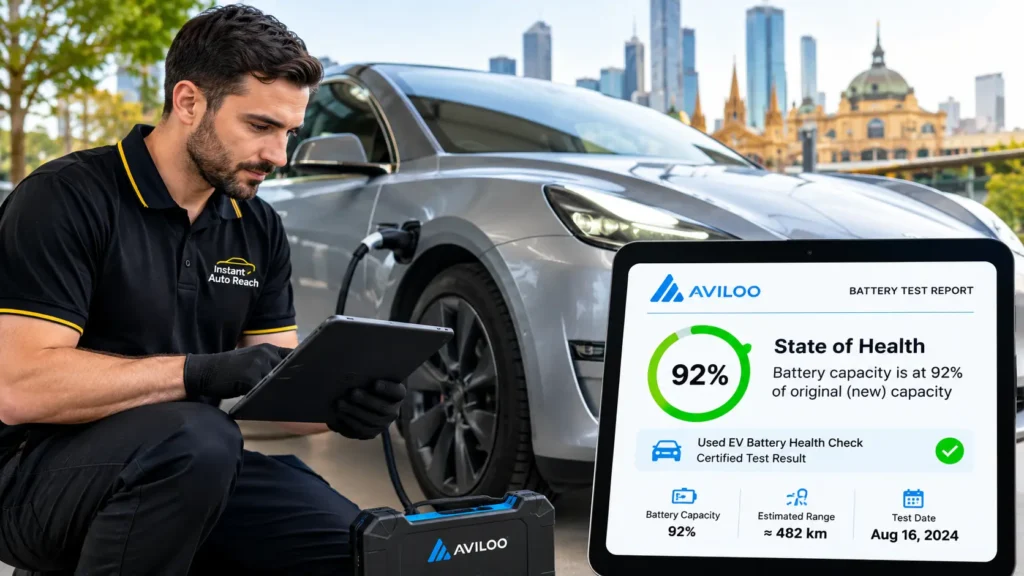
The only reliable way to check a used EV’s battery health is an independent State of Health (SoH) test that reads the battery management system directly – not the range shown on the dashboard. In Melbourne, an Aviloo battery test gives you a certified SoH percentage in minutes. When you buy a used petrol car, the engine is the big risk. On an electric car, it’s the battery, and it’s the one component you can’t judge by looking at it. A used EV can look flawless, drive beautifully on a short test drive, and still have a battery that’s quietly lost 15-20% of its capacity. That’s thousands of dollars of hidden depreciation the seller may not even know about. Why you can’t trust the dashboard range The range estimate on the screen is a prediction based on recent driving, not a measurement of battery health. It shifts with temperature, driving style and how the car was last charged. A car showing ‘380 km’ might have a healthier battery than one showing ‘400 km’ – the number simply isn’t a diagnostic. To know the truth you need the battery’s State of Health (SoH): its current usable capacity compared to when it was new. The three ways to check EV battery health Independent SoH test (best): A device reads the battery management system and calculates a certified State of Health figure. An Aviloo Flash Test takes about 3 minutes via the OBD port; the Premium Test analyses a full charge-discharge cycle for the most detailed result. In-car battery screens: Some EVs show a rough health indicator, but they’re inconsistent and easy for a seller to misread or misrepresent. Charge-to-100% range check: Charging fully and comparing displayed range to the original WLTP figure gives a rough clue, but it’s affected by temperature and calibration – useful as a sanity check, not proof. What a healthy used EV battery looks like Independent fleet data from Geotab’s battery study puts average degradation at about 2.3% per year, leaving a typical battery near 82% capacity after eight years. So a three-year-old EV with a genuine SoH in the low 90s is healthy; one already down in the 80s that early is a warning sign worth investigating. Get it checked before money changes hands A battery test only helps if it’s done before you pay. That’s why our mobile EV inspection comes to the seller’s location across Melbourne, runs a certified battery test plus a full mechanical and electronics check, and gives you a clear report the same day – so you either buy with confidence or walk away before it’s your problem. Instant Auto Reach brings a mobile EV inspection with certified Aviloo battery testing to you anywhere in Melbourne. Call 0402 220 178 or book online – 7 days a week. Frequently Asked Questions